
Uncategorized
Fort Hare in Shock After Fires and Student Unrest

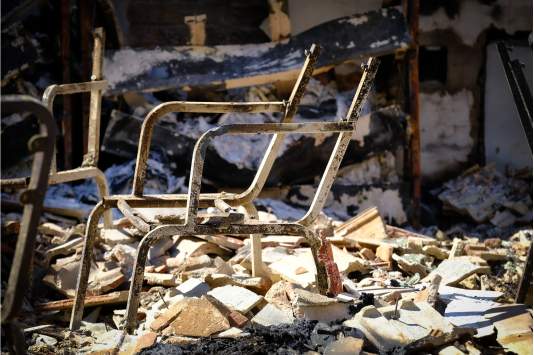
A somber silence hung over the University of Fort Hare (UFH) on Friday morning as members of the Extended Management Team, accompanied by members of the media, walked through the Alice Campus to assess the destruction left behind after the student unrest earlier this week.
What they saw was heartbreaking — charred buildings, collapsed roofs, scorched archives, and the unmistakable scent of loss that now lingers over one of South Africa’s most historic institutions.
“We are sitting on ashes. It is depressing. We are now working on recovery efforts,” said UFH Registrar, Mr Njabulo Zuma, visibly moved as he surveyed what once were bustling academic spaces.
Historic Campus Brought to Its Knees
The fires that ripped through the campus during the unrest have gutted key university facilities, dealing a devastating blow to the 109-year-old institution’s heritage, operations, and academic mission.
Among the structures destroyed are several administrative offices, laboratories, and student support centers — areas that form the operational backbone of the university. While the full extent of the loss is still being quantified, preliminary assessments place the damage between R300 million and R500 million.
But university officials and staff say the real cost cannot be measured in rands.
Beyond infrastructure, the fires consumed years of research data, student records, manuscripts, and irreplaceable archives — part of Fort Hare’s identity as a cradle of African intellectualism. The university, once home to prominent liberation leaders including Nelson Mandela, Oliver Tambo, Govan Mbeki, and Robert Mugabe, now faces one of its darkest chapters since its founding in 1916.
️ A Legacy Under Threat
The University of Fort Hare has long stood as a symbol of African academic excellence and resistance, producing generations of leaders who shaped both South African and continental history.
Now, that legacy stands threatened — not by external forces, but by internal turmoil that has exposed deep-seated tensions between students and management.
While the specific triggers of the recent unrest are still under investigation, preliminary reports suggest it stemmed from protests over financial aid delays and accommodation shortages — issues that have repeatedly sparked tension across South African universities.
Witnesses described the situation as “chaotic” and “tragic.” What began as a peaceful demonstration reportedly escalated into violence, culminating in fires that spread rapidly through administrative buildings during the night.
Leadership Calls for Calm and Rebuilding
UFH leadership has since appealed for unity, restraint, and a renewed sense of purpose as recovery efforts begin.
“This university has survived colonialism, apartheid, and political interference. We will survive this too,” said a visibly emotional Vice-Chancellor, Professor Sakhela Buhlungu, addressing staff after the walkthrough. “But we must take collective responsibility. This destruction hurts our students, our workers, and our province.”
The Eastern Cape Department of Education has expressed support for the university, while Chris Hani District Municipality (CHDM) and Amathole District Municipality have reportedly offered logistical assistance in the short term.
Local contractors, alumni networks, and private sector partners are expected to join the Fort Hare Recovery Task Team, which will oversee damage assessments, security enhancements, and phased reconstruction over the coming months.
Loss Beyond Buildings
Staff and students are still struggling to process the emotional and academic impact of the fires. Several postgraduate researchers lost dissertations, laboratory samples, and personal equipment that took years to build.
“This is not just a university — it’s home for so many of us,” said a postgraduate student in the Faculty of Science. “To see the labs gone and offices burnt is like losing a part of ourselves. Our research, our effort, our memories — all gone overnight.”
The university’s archives — which contained decades of historical records and institutional memory — also sustained severe damage. Preservation teams are now working to salvage whatever can be recovered from the ruins.
⚙️ Recovery Efforts Underway
Despite the devastation, the University of Fort Hare has begun mobilizing its recovery plan, focusing on three key areas:
-
Infrastructure Rehabilitation: Assessing structural damage and prioritizing the rebuilding of essential teaching and administrative spaces.
-
Academic Continuity: Implementing temporary facilities and online systems to ensure that learning and examinations resume with minimal disruption.
-
Student Support: Providing trauma counseling, housing assistance, and communication channels for affected students and staff.
The university has confirmed that academic activities will resume in phases, with certain departments temporarily relocated to unaffected sections of the campus and others moved online.
National Solidarity and Reflection
Messages of support have poured in from across the country — including from other universities, alumni, and political leaders. Many have called for introspection within the higher education sector, urging constructive dialogue over destruction.
The Department of Higher Education and Training is expected to visit the campus next week to evaluate the damage and coordinate national assistance.
“The events at Fort Hare are not just a university issue — they are a national concern,” said a departmental spokesperson. “We cannot rebuild South Africa’s future by destroying its institutions of knowledge.”
A Call for Renewal
As the smoke clears over Alice, a deep sense of loss remains — but so too does the resolve to rebuild. The devastation has united staff, students, and alumni in grief and determination to restore one of Africa’s most storied universities.
Community members from the surrounding Raymond Mhlaba Local Municipality have also stepped in, offering help in clean-up efforts and moral support.
For Fort Hare, a university born in adversity and steeped in resilience, this moment is both a tragedy and a test of endurance.
“Fort Hare will rise again,” said Registrar Njabulo Zuma, standing amid the blackened debris. “It has to. Because when Fort Hare stands, the Eastern Cape stands — and South Africa stands with it.”
University of Fort Hare – Recovery at a Glance
Campus: Alice, Eastern Cape
Incident: Student unrest and fires – early October 2025
Estimated Damage: R300–R500 million
️ Key Losses: Administrative buildings, archives, research facilities
Contact: www.ufh.ac.za
